I once spent a morning shadowing a night crew in a 12,000-square-foot office park. By 6 a.m., three people had cleaned four floors, restocked eleven restrooms, and vacuumed a lobby nobody would walk into for another two hours.
That’s the thing about commercial cleaning services. The best work is invisible. You only notice it when it stops.
So whether you’re a first-time office manager hunting for bids or you’re fed up with the vendor you hired last year, this guide covers what you actually need: real cost ranges, the questions that separate a solid company from a cheap one, and what’s changing in 2027.
What Counts as Commercial Cleaning Services?
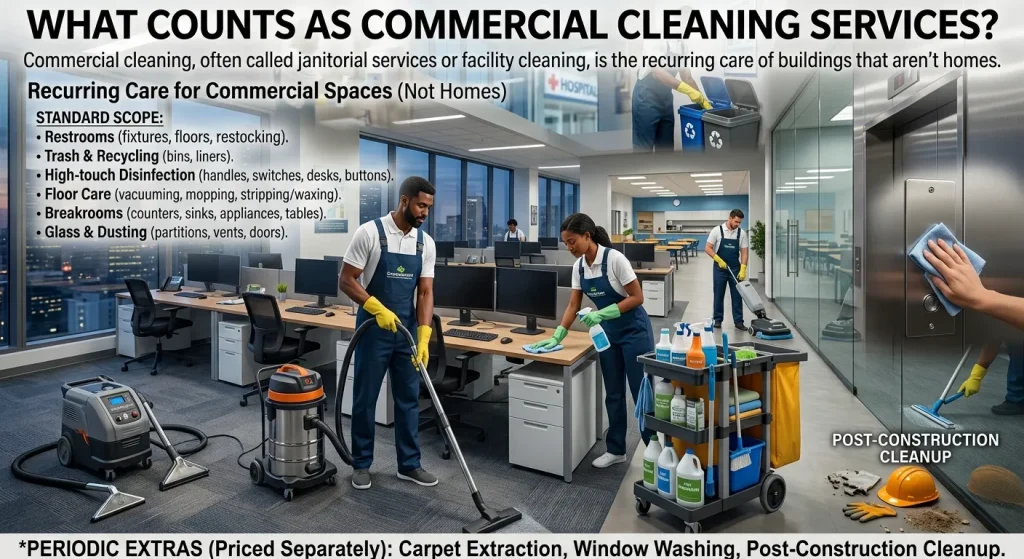
Commercial cleaning, often called janitorial services or facility cleaning, is the recurring care of buildings that aren’t homes. Offices, clinics, retail floors, restaurants, schools, warehouses, gyms. Different buildings, different rules.
A standard scope usually includes:
- Restrooms: Fixtures, floors, restocking paper and soap. This is where 80% of complaints come from.
- Trash and recycling: Emptying bins, swapping liners, hauling it out.
- High-touch disinfection: Handles, switches, shared desks, elevator buttons.
- Floor care: Vacuuming and mopping daily. And must include stripping and waxing a few times a year.
- Breakrooms: Counters, sinks, appliance exteriors, tables.
- Glass and dusting: Partitions, vents, entry doors.
Periodic extras, carpet extraction, window washing and post-construction cleanup usually get priced separately.
Why a Clean Building Pays for Itself
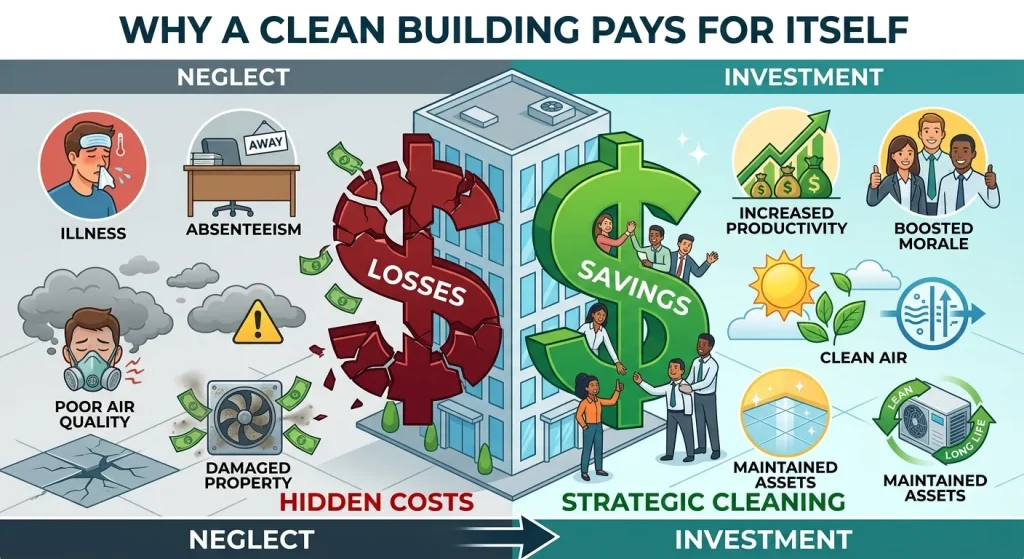
Most people justify cleaning as a “morale thing.” That undersells it.
The U.S. Department of Energy found that proper cleaning can lift productivity by about 6% and cut illness rates by nearly a quarter. The EPA ties poor indoor air quality to roughly $60 billion in lost productivity every year in the US alone.
Translate that to your business. If you’ve got 40 employees and half of them lose two days a year to something they caught at the office, you’re not saving money by skipping the deep clean. You’re just paying for it in sick days instead.
There’s also the boring stuff nobody talks about: floors last longer when they are maintained, HVAC filters clog slower when dust is controlled, and your lease deposit doesn’t evaporate because the carpet got destroyed.
What Commercial Cleaning Services Cost in 2027
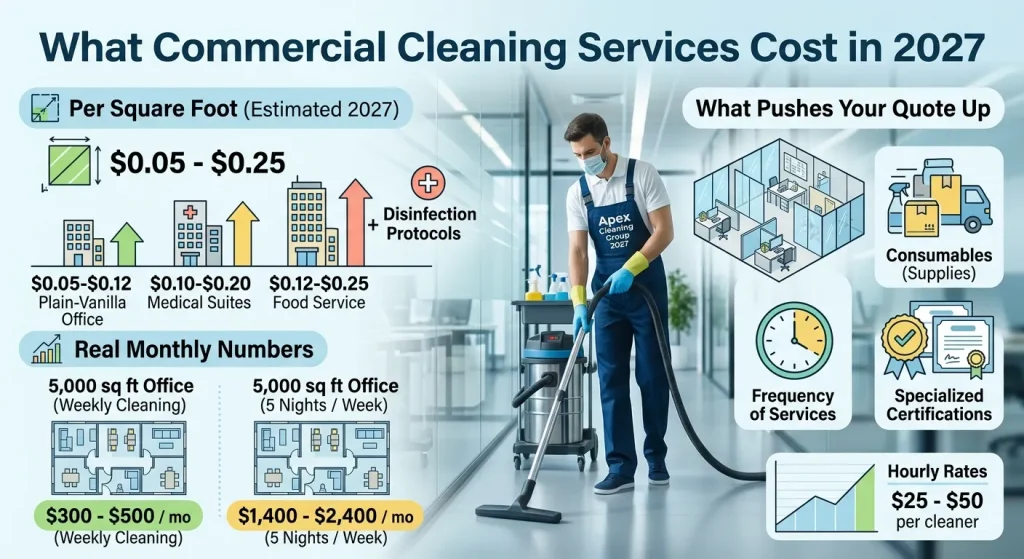
Let’s get specific, because “it depends” is useless when you’re building a budget.
Per square foot
Most providers quote $0.05 to $0.25 per square foot per visit. Plain-vanilla office space sits at the low end, $0.05 to $0.12. Medical suites and food-service areas run 30% to 50% higher because of disinfection protocols and documentation requirements.
Real monthly numbers
- A 5,000 sq ft office, cleaned once a week: roughly $300–$500/month
- The same office, cleaned five nights a week: $1,400–$2,400/month
- Hourly rates, if you’re buying that way: $25–$50 per cleaner
What pushes your quote up
Layout: Cubicle farms with lots of glass and tight corners take longer than open floors. Labor is the biggest line item, so time is money.
Consumables: If the company supplies toilet paper, towels, and soap, expect a 15–20% markup. Sometimes that’s worth it. Sometimes you’re better off buying your own.
Frequency: Obviously. But here’s the trap: cutting from five nights to three doesn’t always save 40%. Some tasks (restrooms, trash) can’t wait two days.
Certifications: Cleanrooms, labs, and surgical suites need trained, sometimes badged staff. That costs more, and it should.
How to Vet a Commercial Cleaning Company
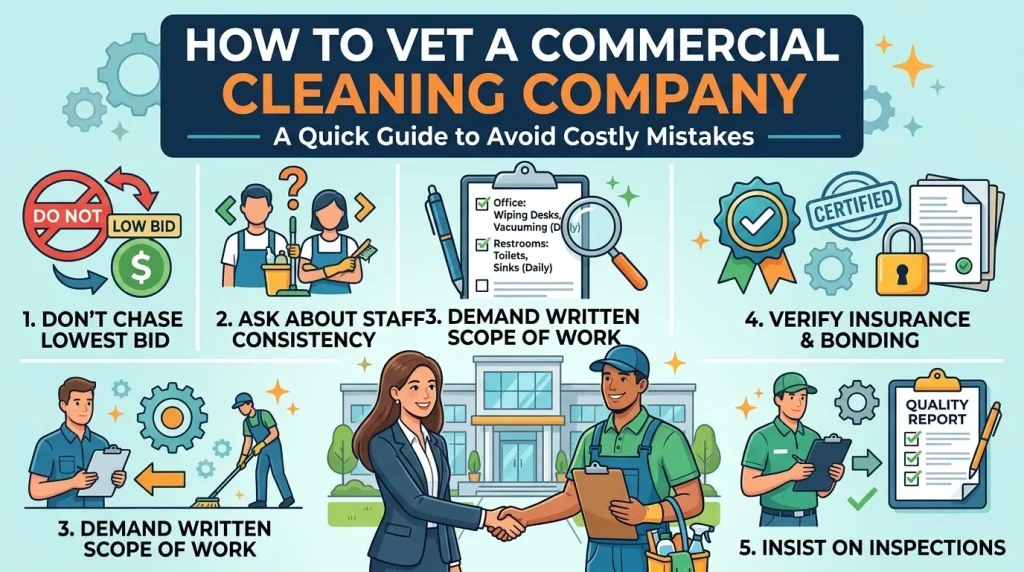
This is where most people get burned. Here’s my short list.
Don’t chase the lowest bid.
I’ve watched this play out a dozen times. The lowest quote wins, and six weeks later the crew is rushing through in half the allotted time because the contract was priced too thin to begin with. Cheap cleaning isn’t cheaper. It’s just later.
Ask what’s included, how many labor hours are allocated, and how they measure quality.
Ask who actually shows up.
Will you get a dedicated team, or a rotating cast of whoever’s available? Turnover is brutal in this industry. A steady crew learns your building, knows which doors stick, remembers that the third-floor tenant hates lemon scent. Ask how they handle callouts and vacations.
Demand a written scope of work.
If it isn’t written down, it isn’t happening. Get a task list by area and frequency. Vague contracts are how you end up paying for “dusting”; that means “wiping two desks.”
Verify insurance and bonding.
Non-negotiable. Ask for a certificate of insurance. If someone gets hurt on your property or a laptop goes missing, you want that covered.
Insist on inspections
Even good crews drift without checklists and site visits. Ask how often a supervisor walks the building and how you’ll be notified of issues. Monthly quality reports are a good sign. Silence is not.
Trends Shaping the Industry in 2027
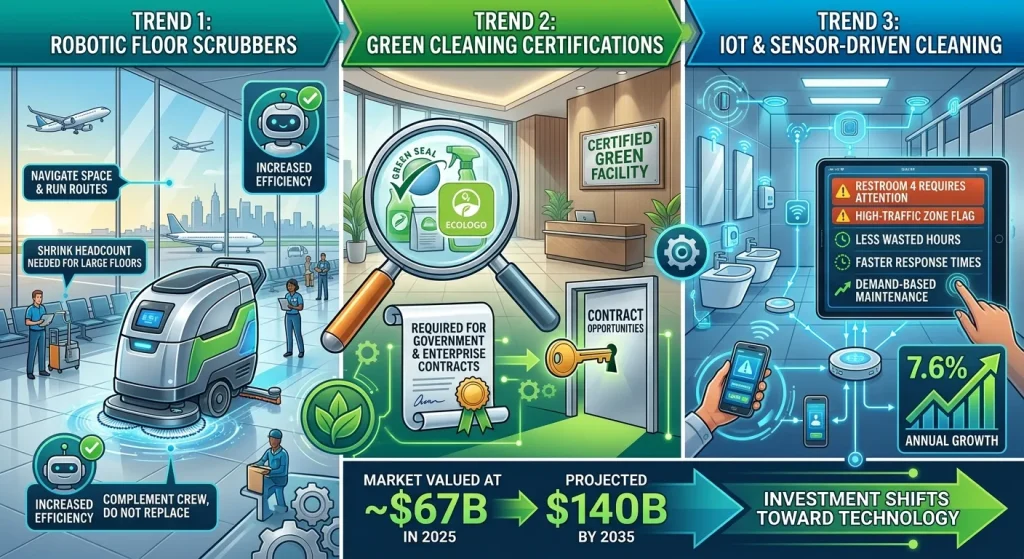
The global commercial cleaning market was valued at around $67 billion in 2025** and is projected to hit **$140 billion by 2035, roughly 7.6% annual growth. A lot of that money is going toward technology.
Robotic floor scrubbers: These are already common in big-box retail and airports. They map a space, run a route, and don’t call in sick. They are not replacing crews, but they are shrinking the headcount needed for large open floors.
Green cleaning certifications: These have moved from marketing to gatekeeping. Green Seal or EcoLogo credentials are frequently required for government and enterprise contracts. If your provider can’t produce them, they’re locked out of heavy work.
IoT and sensor-driven cleaning: That’s steam up in restrooms and high-traffic zones. Sensors flag when a room needs attention instead of waiting for the nightly visit. Less wasted hours, faster response times.
Quick Answers
How often should an office be professionally cleaned?
Most offices do well with three to five visits per week. Low-traffic spaces can get by on one or two. Restrooms and trash dictate the minimum.
Are commercial cleaning services worth it for a small business?
If you have more than ten employees and a shared restroom, yes. The labor math rarely favors DIY once you factor in supplies, turnover, and the time your own staff spends on it.
What’s the difference between commercial cleaning and janitorial services?
Mostly semantics. “Janitorial” usually implies day-to-day upkeep; “commercial cleaning” can include both routine work and specialized services like carpet extraction or post-construction cleanup.
The Short Version
Commercial cleaning services aren’t a line item you should shave to the bone. These services protect your employees’ health, your building’s lifespan, and your reputation with every client who walks through the door.
Pick a provider who writes things down, shows up with the same faces, and can prove what they’ve done. Pay a fair price for it. Then forget they exist because that’s the whole point.